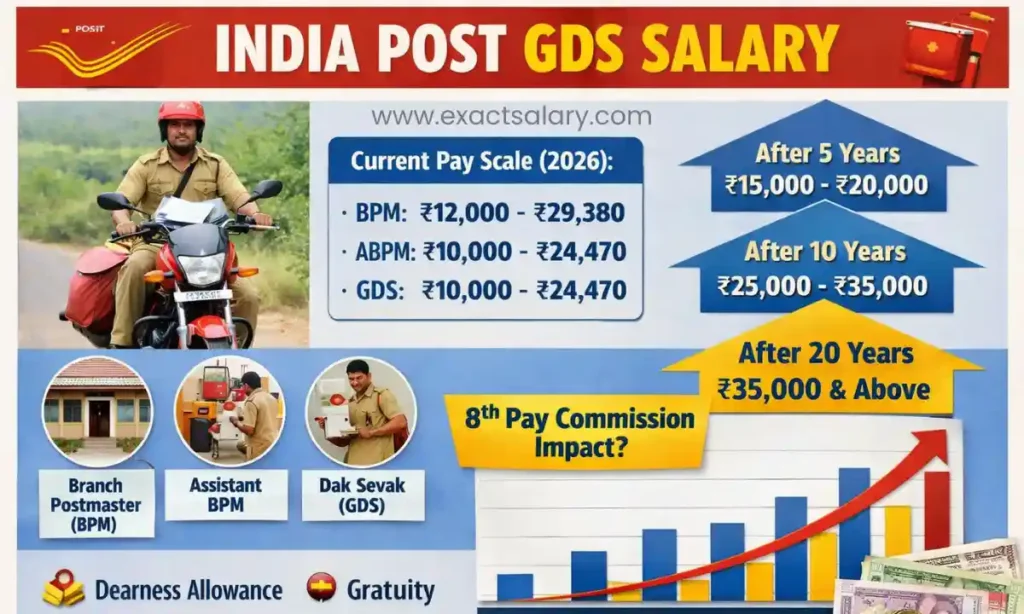
India Post Gramin Dak Sevak (GDS) Jobs are the most preferred choices for government jobs seeking candidates of 10th class level who seek job that provide a stable income with periodical pay increases and benefits. This guide includes everything—from GDS salary per month to how salary increases over time after 5,10 and even 20 years, to paid revisions like the 8th Pay Commission trends.
What is the India Post GDS Role?
GDS is a position provided by the Department of Posts for its rural postal division of Indian Post offices. It includes supervising the distribution of mail to rural areas, ensuring that mail and parcels are collected by carriers on schedule, helping with general office duties. GDS staff usually perform duties including post today, keeping records and dealing with members of the public. This role can be asymmetrically divided into three parts:
- Branch Postmaster (BPM) – Responsible for managing the operations of the branch post office.
- Assistant Branch Postmaster (ABPM) – Assists the BPM with the operations and customer service at the branch.
- Dak Sevak (GDS) – Performs a variety of delivery and support tasks under the supervision of BPM and ABPM.
India Post GDS Salary Per Month (2026 Pay Scale)
The GDS salary is determined on the basis of Time Related Continuity Allowance (TRCA) and is related to the number of hours worked every day. There, it is the base pay for GDS workers. Here’s a breakdown of the average monthly pay:
| Post | Monthly Pay Scale |
|---|---|
| Branch Postmaster (BPM) | ₹12,000 – ₹29,380 |
| Assistant Branch Postmaster (ABPM) | ₹10,000 – ₹24,470 |
| Gramin Dak Sevak (GDS) | ₹10,000 – ₹24,470 |
What Makes Up the GDS Salary?
The GDS pay comprises of many elements. The main element is the Time Related Continuity Allowance (TRCA) which relates to hours worked. Moreover, inflation linked Dearness Allowance (DA) is also being given. Other facilities like provident fund and social security schemes are also available on the employee’s length of service.
In‑Hand Salary Explained
In‑hand salary is what you get after all the deductions from gross salary. In‑Hand Salary for GDS For the Gramin Dak Sevaks employees, the in‑hand salary may represent:
- TRCA Base Pay
- Dearness Allowance
- Any applicable hourly pay increase
For instance a full working BPM of GDS can be paid up to an in‑hand salary of ₹29,380 per month.
GDS Salary After 5 Years
So, the Gramin Dak Sevak pay now lies at Stage 1 and it is increased after about 5 years in service or so with TRCA increment frequency and DA hikes. This is how much a GDS employee will make after 5 years, according to the position:
| Post | Monthly Salary (5 Years) |
|---|---|
| GDS BPM | ₹15,000 – ₹20,000 |
| GDS ABPM | ₹12,000 – ₹18,000 |
| GDS Sevak | ₹12,000 – ₹18,000 |
GDS Salary After 10 Years
For GDS employees serving the post for 10 years, the salary becomes almost double because of continued service and seniority in the role and allowances. The approximate salary after serving of the 10 years would be:
| Post | Monthly Salary (10 Years) |
|---|---|
| GDS BPM | ₹25,000 – ₹35,000+ |
| GDS ABPM | ₹20,000 – ₹30,000 |
| GDS Sevak | ₹20,000 – ₹28,000 |
GDS Salary After 20 Years
The GDS salary gets raised over time with regular increments and role-based promotion, unlike other government jobs that are paid a static pay structure. The truth is when GDS serve for 20 years, they will definitely get higher TRCA levels plus an extra DA component resulting in increase of their monthly income. But the increase is not automatically in line with its regular government pay scales and can vary according to location, seniority and other factors.
If the person has been employed for less than 20 years, then he will be paid less based on their experience and responsibility.
Impact of 8th Pay Commission on GDS Salary
This 8th Pay Commission is likely to change the salary structure of the government employees in different services, including GDS. Though the pay of Gramin Dak Sevaks (GDS) is not included in pay matrix for civil servants, still a proposal has been made that their wages will come under new pay panel recommendations in future.
Currently, GDS pay is effectively TRCA based with some modifications but it may be influenced more by the next pay commissions towards parity with regular civil service salary.
Allowances and Benefits
Apart from the fixed salary, there are multiple GDS allowances and benefits available. These include:
- Dearness Allowance (DA), which is revised twice a year and is based on inflation.
- Gratuity and other social security benefits, which may be available depending on the employee’s length of service.
These allowances,+benefits etc. are very much instrumental in enhancing the total remuneration of long serving GDS employees.
Conclusion
The India Post GDS pay offers a steady employment and opportunity to grow in future. Employees has a pay scale that begins at the base salary and rises with TRCA increments, DA adjustments & seniority increment over 5 years/10 years or sometimes 20 years. The job not only pays a reliable salary but has the potential to lead to a satisfying career in public service. Also, 8th Pay Commission talks may result in prospective increase in salaries that would also boost the GDS pay structure.
FAQs
What is the basic GDS salary per month?
The GDS salary per month usually starts from ₹10,000 and can go up to ₹29,380 depending on the post and working hours.
Does GDS salary increase over time?
Yes, TRCA increments and DA hikes help the salary grow after 5, 10, and more years.
Do GDS employees get allowances?
GDS staff receive DA and sometimes other benefits like social security schemes, depending on policy.
Can GDS salary reach ₹35,000+?
With seniority and years of service (10+), monthly earnings in higher brackets like ₹25,000 – ₹35,000 are possible depending on performance and role.
Also, Read About: GST Inspector Salary Per Month in 2026 | Pay Scale, Growth & Benefits