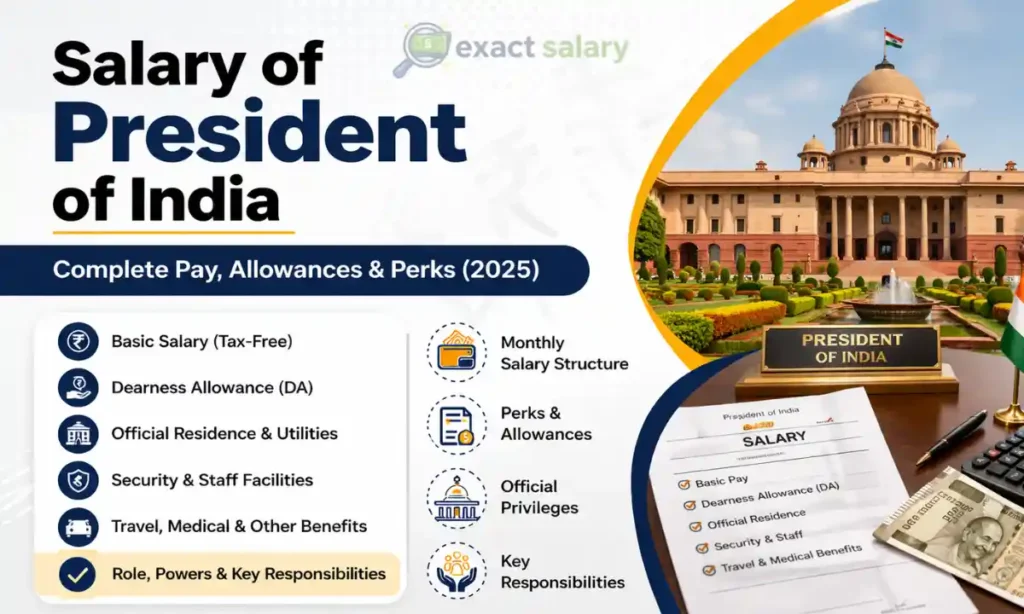
The President of India occupies the highest constitutional office in India. Acting as the symbol of unity among people in the country, the President undertakes some very important ceremonies, constitutional duties, and responsibilities. In addition to all these roles, the President receives an amount of salary along with many other perks and allowances. Let us take a look at the salary of the President of India, their powers, and post-retirement benefits in this article.
Who is the President of India?
As per the Constitution of India, the President of India is the head of the State and the first citizen of India. Though the President’s role is largely symbolic in nature, it carries great significance in India’s constitutional system. The President acts as the representative of the nation at home as well as abroad.
Currently, the 15th President of India is Droupadi Murmu, who took oath on July 25, 2022. She is the first woman president from a tribal background in India.
What is the Salary of President of India Per Month
Monthly Salary
The monthly salary of the President of India is ₹5,00,000 (five lakh rupees). It is worth noting that this amount is higher than the old salary of ₹1.5 lakh paid in 2018 due to the growing responsibility and prestige of the post.
Annual Salary
This means that the annual salary amounts to approximately ₹60,00,000 (sixty lakh rupees).
Allowances and Benefits
The President of India has various allowances and benefits in order to perform his official functions successfully
Official Residence – Rashtrapati Bhavan
The residence of the President is known as Rashtrapati Bhavan located in New Delhi. This building consisting of more than 300 rooms is home to many employees working in this building as well as hosts many state occasions.
Travel and Transport
In addition, the President is entitled to using the air plane for travels. Moreover, the President is provided with special cars for protection.
Medical Facilities
The President and his/her immediate family are eligible for free medical facilities during and even after his/her term. It involves medical treatment in government hospitals, etc.
Secretarial Support and Staff
There is provision for providing secretarial assistance to the President and personal staff, as required to carry out various official and ceremonial duties.
Other Benefits
- State Banquets: The President hosts state banquets and events that represent India’s global relationships.
- Free Domestic Travel: Travel within India for official duties is fully funded by the government.
- International Travel: International travel for diplomatic purposes is arranged and funded by the government.
Duties and Powers of the President
Though, mainly a ceremonial functionary, the President has several powers as per the Indian Constitution. These powers are to be exercised mainly on the advice of the Cabinet. However, there could be some exceptions.
Constitutional Role
The President acts as the unifying factor in India and ensures adherence to the provisions of the constitution. He/She acts as the representative of the country in all international events as the head of the state.
Executive Powers
The President of India holds executive authority, which includes the power to:
- Appoint the Prime Minister and other ministers.
- Appoint judges to the Supreme Court and High Courts.
- Appoint Governors of Indian states.
- Exercise these powers during national emergencies, state emergencies, and financial crises.
Although the President exercises these powers on the advice of the Council of Ministers, the role remains crucial during times of constitutional crises or national emergencies.
Legislative Powers
The President also has significant legislative functions. They can:
- Summon and prorogue sessions of Parliament.
- Dissolve the Lok Sabha (Lower House of Parliament).
- Sign bills into law and may return a bill (except money bills) for reconsideration.
Judicial Powers
As per the Indian Constitution, the President possesses some judicial powers. It includes pardoning powers to grant pardon, reprieve, respite and commuting sentences in some special cases like death sentences as per Article 72.
Role in National Emergencies
In case of national emergencies, the President is the key functionary who possesses the authority to proclaim the situation of national emergencies.
National Emergency (Article 352)
A national emergency can be declared by the President in case of war, foreign aggression or civil rebellion. Under such situations, the entire governance of the country is under the control of the central government.
State Emergency (Article 356)
If a state government fails to act in accordance with the constitution, the President can invoke President’s Rule (state emergency). This gives complete control of the state government to the central government.
Financial Emergency (Article 360)
Under a financial emergency, the President can proclaim it in case of serious financial instability prevailing in the country. It grants exceptional powers to the central government.
Post-Retirement Benefits
Various post-retirement benefits are to be provided to the President, to uphold the honor and respect of the President.
| Benefit | Details |
|---|---|
| Pension | ₹1,50,000 per month (approx.) |
| Accommodation | Rent-free, fully furnished government accommodation |
| Medical Care | Lifetime medical facilities |
| Travel | Travel allowances for domestic and international trips |
| Support Staff | Secretarial and administrative support |
Comparison with Other High Officials in India
When compared to other high-ranking officials in India, the President’s salary is among the highest for constitutional officeholders.
| Position | Monthly Salary |
|---|---|
| President of India | ₹5,00,000 |
| Vice President of India | ₹4,00,000 |
| Prime Minister of India | ₹1,66,000 (approx.) |
| Governor of State | ₹3,50,000 (approx.) |
Though the President’s salary is the highest among constitutional offices, it is still considerably lower than the salaries of corporate executives or foreign heads of state, underlining the commitment to public service.
Conclusion
The salary of the President of India is ₹5,00,000 per month. In addition to this, there are several other advantages associated with the post. These include a residence, traveling facilities, and even free healthcare. It carries with it constitutional powers and responsibilities. It is an office that is very important for the management of the country, especially in times of emergencies.
FAQs
What is the monthly salary of the President of India?
The monthly salary of the President of India is ₹5,00,000 (five lakh rupees).
What are the key perks and benefits of the President of India?
The President receives official residence, special transport, lifetime medical care, and secretarial support.
What is the post-retirement pension for the President of India?
The President receives a pension of ₹1,50,000 per month after retirement.
How does the President of India’s salary compare with other government officials?
The President earns the highest salary among constitutional officials, followed by the Vice President and Prime Minister.
Also, Read About: UP Home Guard Salary 2026 – In‑Hand Pay, Allowances & Career Growth